
Why Does My Dog Bark So Much? 6 Causes & What Actually Helps
Estimated read time: 5 minutes

If you're asking yourself "why does my dog bark so much," you're not alone. If your dog's barking has you at your wit's end — the neighbors are dropping hints, your Zoom calls are a disaster, and you're Googling solutions at 2 a.m. — take a breath. You're not a bad pet parent, and your dog isn't a "bad dog."
Barking is completely natural canine communication. But when it becomes excessive, it's usually a sign that something needs your attention.
The most important thing you can do before buying any training tool, hiring a trainer, or trying a new technique? Understand why your dog is barking in the first place. Because the solution that works depends entirely on the cause.
6 Reasons Your Dog Barks So Much (and How to Help)
Not all barking is created equal. Here's what your dog might actually be trying to tell you:

1. Alert & Territorial Barking 🏠

What it looks like: Your dog barks when someone walks past the house, when the doorbell rings, at other dogs passing by the window, or at sounds outside. They may stiffen up, raise their hackles, or position themselves between you and the "threat."
What's happening: Your dog thinks they're doing their job — protecting the home. And from their perspective, it works every time: the mail carrier always leaves. The neighbor always walks away. As far as your dog is concerned, their barking saved the day. This makes it a self-reinforcing behavior that gets harder to change over time.
What helps: Block the view with window film or curtains. Teach a "quiet" cue paired with treats. Use a brief interrupter (like your voice, a hand clap, or an ultrasonic training aid) to break the barking cycle, then immediately redirect with a command and reward. The goal isn't to punish the alert — it's to teach your dog that they can stand down after one or two barks.
2. Boredom & Under-Stimulation 😴
What it looks like: Barking that happens when your dog is left alone for long periods, or seemingly at nothing in particular. May be accompanied by pacing, chewing, digging, or other destructive behaviors.
What's happening: Dogs need mental and physical stimulation every single day. Without enough exercise, enrichment, or social interaction, barking becomes their entertainment. A bored dog is an inventive dog — and that invention often involves noise.
What helps: More daily exercise (a tired dog is a quieter dog), puzzle toys like our Orbilini™ Treat Toy, sniff walks, training sessions, and interactive play. If you work long hours, consider a dog walker or daycare for social breeds. This is one cause where no tool or device will fix it alone — the real solution is lifestyle enrichment.
3. Attention-Seeking Barking 👀
What it looks like: Your dog barks directly at you when they want food, play, a walk, or just your attention. They may stare at you while barking. If you respond — even to say "be quiet!" — the barking often intensifies over time.
What's happening: Your dog has learned that barking gets results. Even negative attention (yelling, looking at them, telling them to stop) counts as a reward in their mind. You're accidentally training them to bark more.
What helps: Completely ignore the barking — no eye contact, no talking, no reaction. The moment they stop and give you even a few seconds of calm behavior, reward them immediately. Fair warning: the barking will get worse before it gets better (this is called an "extinction burst"). Stay consistent and you'll see results.
4. Fear & Anxiety Barking 😰

What it looks like: High-pitched, frantic barking when encountering strangers, other dogs, loud noises, new environments, or specific triggers. Body language often includes a tucked tail, whale eyes (showing the whites), cowering, or trying to retreat.
What's happening: Your dog is genuinely scared, and barking is their way of saying "stay away!" This is not a behavior problem — it's an emotional response.
What helps: Create more distance from the trigger. Gradual desensitization with positive associations (treats in the presence of the scary thing, at a comfortable distance) is the proven approach. Be cautious with any interrupter tool for fear-based barking — adding more stimulation to an already overwhelmed dog can make things worse. For moderate to severe fear, work with a certified trainer or veterinary behaviorist.
5. Separation Anxiety 💔

What it looks like: Barking, howling, or whining that starts when you leave and continues while you're gone. Often accompanied by pacing, destruction (especially around doors and windows), house soiling, and signs of extreme distress.
What's happening: Your dog is genuinely panicking when left alone. This is one of the most misunderstood and undertreated behavioral issues in dogs. It's not spite, it's not stubbornness, and it's not something a barking device can fix.
What helps: Gradual alone-time training, calming supplements (talk to your vet), puzzle toys for enrichment, and in moderate to severe cases, medication from your veterinarian combined with a behavior modification plan. We actually wrote a full guide on this — check out No More Goodbye Grief: A Dog Parent's Handbook for Separation Anxiety right here on The Pet Portal.
6. Excitement & Play Barking 🎉
What it looks like: Barking when you come home, before a walk, during play, or when they see another dog they want to greet. Usually accompanied by a wagging tail, bouncing, and general joy.
What's happening: Your dog is expressing pure excitement. This is probably the least concerning type of barking, but it can still be excessive and disruptive — especially when guests arrive or you're trying to clip on a leash.
What helps: Stay calm yourself (hard, we know). Wait for a moment of quiet before giving attention or starting the activity. Practice "calm greetings" by ignoring your dog until they settle, then rewarding the calm. A brief interrupter can help break the frenzy so you can redirect to a "sit" before proceeding.
The Approach That Actually Works: Interrupt → Redirect → Reward

Regardless of the cause, the most effective approach to managing unwanted barking follows a simple pattern:
1. Interrupt the barking to break your dog's focus (a sharp sound, your voice, an ultrasonic aid, or simply removing the trigger).
2. Redirect to a desired behavior — "come," "sit," "leave it," or going to their bed.
3. Reward the new behavior immediately with treats, praise, or play.
This is the same framework recommended by organizations like the ASPCA and the AKC, and used by veterinary behaviorists worldwide. The interrupt can come from many sources — your voice, a hand clap, a treat tossed on the floor, or a tool like an ultrasonic training aid. What matters most is what happens after the interrupt: the redirect and the reward.
Without the follow-through, any interrupter (including your voice) is just noise — and your dog will eventually tune it out.
Where Tools Like the Bark Buster™ Fit In
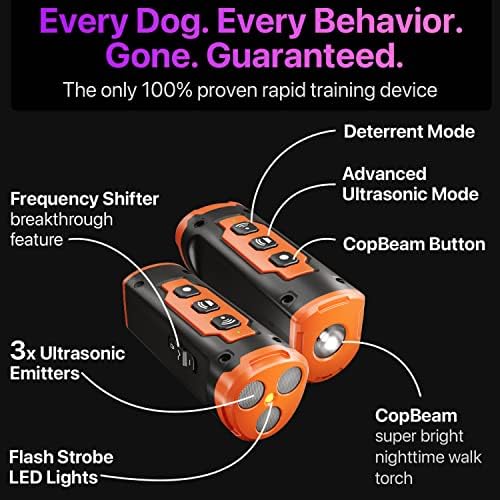
We sell the Bark Buster™ Ultrasonic Dog Training Aid here at Amani Reign, and we want to be straight with you about what it is and what it isn't.
What it is:
- A handheld tool that uses ultrasonic sound to briefly grab your dog's attention
- Shock-free, collar-free, and gentle
- Helpful as Step 1 of the Interrupt → Redirect → Reward method
- Effective for many dogs, especially for alert/territorial and excitement barking
What it isn't:
- A cure-all or magic fix for all barking
- A replacement for training, exercise, and enrichment
- Appropriate for fear-based or anxiety-based barking without professional guidance
- Guaranteed to work on every dog (nothing is — and anyone who tells you otherwise isn't being honest)
If you think it might be a good fit for your situation, check out the Bark Buster™ product page for full details, specs, and our 100-Day Return Policy. If it doesn't work for your dog, that's okay — we've got you covered.
5 Things You Can Start Doing Today (No Products Required)

Before you buy anything, try these free, trainer-recommended strategies:
1. Figure out the trigger. Spend a few days keeping a simple "barking log." Note when, where, and at what your dog barks. Patterns will emerge fast and point you toward the right solution.
2. Add more exercise and enrichment. A 30-minute walk plus a 10-minute training session or puzzle toy can make a surprising difference. Tired brains bark less.
3. Manage the environment. If your dog barks at the window, block the view. If they bark at the doorbell, use white noise or music. Sometimes the simplest fix is removing the trigger entirely.
4. Reward the quiet. We spend so much energy reacting to barking that we forget to notice when our dog is being calm. Catch them being quiet and reward it — this is one of the most powerful things you can do.
5. Don't yell back. To your dog, you yelling "STOP BARKING!" sounds like you're joining in. Stay calm, redirect quietly, and reward the behavior you actually want.
The Bottom Line
Your dog is barking for a reason. Once you understand that reason, you can choose the right combination of training, management, enrichment, and tools to help. There's no shame in needing help — that's what we're here for.
At Amani Reign, we believe in kindness-first pet parenting. That means recommending what's actually good for your dog, being honest about what our products can and can't do, and supporting you with real information — not just sales pitches.
Because we love them, like you do. 💚

Every purchase helps support lost and abandoned pets. 💚
FAQ: Dog Barking Questions Answered
Q: Is it normal if my dog barks all day when I'm at work?
A: Not ideal, but common. If your dog barks excessively when left alone, it usually signals boredom, under-stimulation, or anxiety. A combination of morning exercise, puzzle toys, and gradual alone-time training can help. For severe cases, consider a dog walker or daycare for midday breaks.
Q: Do ultrasonic dog bark devices really work?
A: They work for some dogs, not all. Ultrasonic interrupters like the Bark Buster can effectively grab attention, but they're only Step 1. The real magic happens in Steps 2 and 3: redirecting to a desired behavior and rewarding it. Without follow-through training, even the best tool becomes just noise.
Q: How do I get my dog to stop barking at the doorbell?
A: Block the trigger temporarily (close curtains, use white noise) while training. Teach your dog a "quiet" cue, and reward calm behavior at the door. Some people train a different behavior entirely—like going to a bed when the doorbell rings—to replace alert barking with a positive habit.Boredom
Related Reading on The Pet Portal
🐾 Bark Buster™ Ultrasonic Dog Training Aid
🐾 No More Goodbye Grief: A Dog Parent's Handbook for Separation Anxiety
🐾 Bringing Harmony Home: 10-Step Guide to Introducing Cats & Dogs